Researchers recover 42 lost pages of 'ghost' text from ancient New Testament manuscript
A team led by a University of Glasgow professor has recovered 42 previously lost pages from one of the most significant early copies of the New Testament, a sixth-century manuscript known as Codex H, by using advanced imaging technology to read text invisible to the naked eye.
The discovery, announced in an April 24 University of Glasgow press release, offers a rare window into how the Letters of St. Paul were copied, corrected, and studied by generations of scribes and readers across more than a millennium. For anyone who takes the transmission of Scripture seriously, this is the kind of find that matters.
Codex H dates to the sixth century and contains the Letters of St. Paul. In the 13th century, monks at the Megisti Lavra monastery on Mount Athos in Greece disassembled the aging manuscript and reused its parchment pages as binding material and flyleaves to repair other books in their collection. Since then, the pages have been scattered across libraries in Europe. Some surviving fragments ended up at the University of Glasgow.
How 'ghost' text led to a breakthrough
The key to the recovery was a process that began with a simple observation: someone had re-inked the entire manuscript at some point during its working life. Garrick Allen, the University of Glasgow professor who led the project, told Fox News Digital that the re-inking was an ancient attempt to keep the book usable for a new generation.
"The book was re-inked in its entirety at some point in its working life, meaning that someone rewrote over the existing text... in an attempt to keep the book usable for a new generation."
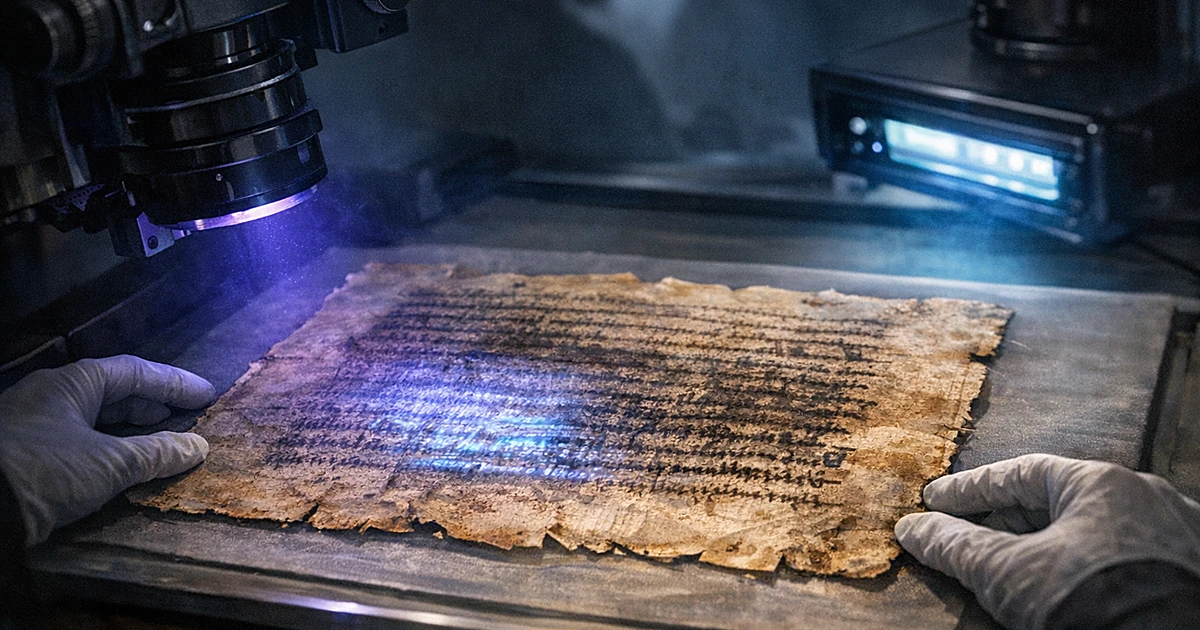
That re-inking created faint mirror-image traces, "ghost" text, on adjacent pages. Researchers then used multispectral imaging to read those traces, recovering text that no human eye could see unaided. The Washington Times reported that the offset damage from the later re-inking in the palimpsest was precisely what made the invisible text recoverable.
The result: 42 pages of content that had been considered lost for centuries.
What the recovered pages reveal
The recovered material is not a previously unknown letter from Paul. It is something arguably more useful to scholars of early Christianity: direct evidence of how scribes and readers engaged with the apostle's writings in the centuries after they were first set down.
Allen described over 70 corrections to the text made by a scribe who compared Codex H against another manuscript. The pages also contain annotations from at least 15 later readers who left behind prayers, poems, grammatical notes, and other marks. The University of Glasgow press release stated that the fragments show "how 6th-century scribes corrected, annotated and interacted with sacred texts" and "how sacred works were reused and repurposed once they fell into disrepair."
The recovered pages also include ancient chapter lists that, as the university noted, "differ drastically from how we divide these letters today." That detail alone could reshape how scholars understand the early organization of Pauline literature, a subject with direct bearing on how Christians have read and structured the New Testament for nearly two thousand years.
Allen put the significance plainly:
"It's an important witness to the text of Paul's Letters in a period where we don't have that many manuscripts."
That period, roughly the sixth through ninth centuries, is a gap in the manuscript record that has long frustrated New Testament scholars. Codex H, with its layers of corrections and reader notes spanning more than 1,000 years, helps fill it.
A medieval recycling project preserved what might have been lost forever
The irony of the story is hard to miss. The very act that seemed to destroy the manuscript, tearing it apart for scrap parchment, is what saved it. Allen explained that after six or seven centuries of use, the book had simply worn out.
"Six hundred to 700 years is a long time for a book to be kept in working order, even though we know that at least one person attempted to conserve it during this period through re-copying."
Parchment was expensive to produce, especially in a remote location like Mount Athos. Allen said it made sense that the monastery reused the manuscript to maintain other books in their library. The pages survived precisely because they were repurposed, tucked inside the bindings of other volumes, where they sat unread for centuries.
This kind of accidental preservation echoes other discoveries where ancient artifacts tied to the Christian faith have surfaced in unlikely places, reminding us that the material record of Scripture is far richer than what sits on display in museums.
Allen called the anonymous monks who repurposed the parchment "medieval conservationists", though not in the modern sense. Their goal was practical, not archival. But the unintended result was preservation.
"We have recovered [these pages] only due to the unintended results of a medieval conservationist."
The human fingerprints on sacred text
One of the most striking aspects of the find is the sheer volume of human interaction recorded on the pages. Fifteen or more readers left their marks, prayers, poems, grammatical observations. Allen noted that such annotations are common in ancient manuscripts, but Codex H's long and varied life attracted an unusual number of them.
"These types of notes are not unusual but, because Codex H had such a long life in many forms, its pages attracted many interested readers, and these annotations are often the only tangible evidence left that these anonymous people existed."
That line deserves a moment. These were real people, monks, scholars, perhaps ordinary believers, who sat with Paul's letters, read them, prayed over them, and left behind the only proof that they ever lived. In an age that often treats the Bible as a political football or a cultural artifact to be deconstructed, the recovered pages of Codex H offer something different: evidence of people who took the text seriously enough to study it, correct it, and pass it on.
The same impulse that drove those anonymous readers drives modern efforts to recover lost biblical history, a conviction that these documents matter, and that the physical record of how they were transmitted is worth pursuing.
A model for future discoveries
Allen expressed optimism that the methods used on Codex H could be applied more broadly. He described a collaborative model involving manuscript scholars, biblical scholars, imaging specialists, data scientists, monastic communities, museums, and local partners.
"Although each manuscript is by definition unique and presents its own challenges, we think that we've developed a model for working with challenging manuscripts like palimpsests at a larger scale."
He added that the process "makes me optimistic that many ancient manuscripts still have much more to tell us about the people who made and used them." If that optimism is warranted, similar recoveries could follow, and the manuscript record of the New Testament could grow in ways scholars a generation ago would not have imagined.
That possibility carries weight at a time when scientific investigation of biblical sites and texts continues to produce results, from radar scans at Mount Ararat to major archaeological finds across the ancient Near East.
What remains unknown
Several questions remain open. The specific passages from Paul's letters that were recovered have not been detailed publicly. The exact libraries across Europe that hold the scattered pages of Codex H are not identified in the available reporting. And the full scope of what the ancient chapter lists reveal about early Pauline organization has yet to be published in detail.
Discoveries like these, and archaeological finds at sites tied to the biblical world, tend to generate more questions than they answer. But they also tend to confirm something that believers have always understood: the text endures, even when the people who carried it are forgotten.
Forty-two pages, hidden for centuries in the bindings of other books, read by light no human eye can see. The monks who tore them apart thought they were recycling scrap. They were preserving Scripture.