Survey of 2,000 young men reveals a generation adrift — and the institutions that failed them
Nearly half of young American men say they believe they are failures, more look up to Barack Obama than to any religious leader, and one in eight has been incarcerated, according to a sweeping new survey that paints a grim portrait of male disillusionment in modern America.
The Institute of Family Studies surveyed 2,000 young men across the country and found a generation caught between ambitions they can articulate and a world that offers them fewer and fewer paths to reach them. Forty-three percent agreed with the statement "I am inclined to think I am a failure." More than 60 percent said they feel they have little control over the things that happen to them. And 73 percent said that in recent decades it has become harder to know what it means to be a man.
Joseph E. Davis, a research professor of sociology at the University of Virginia and director of the Picturing the Human Project at the Institute for Advanced Studies in Culture, authored the commentary presenting the findings. His conclusion was blunt: these young men want the things their fathers and grandfathers wanted, marriage, children, financial independence, but they cannot find the road to get there.
Fathers absent, churches empty, and nowhere left to turn
The survey found that only about 60 percent of respondents reported having a consistently present father. That means roughly four in ten young men grew up without a reliable male figure in the home, a deficit that ripples through every other finding in the data.
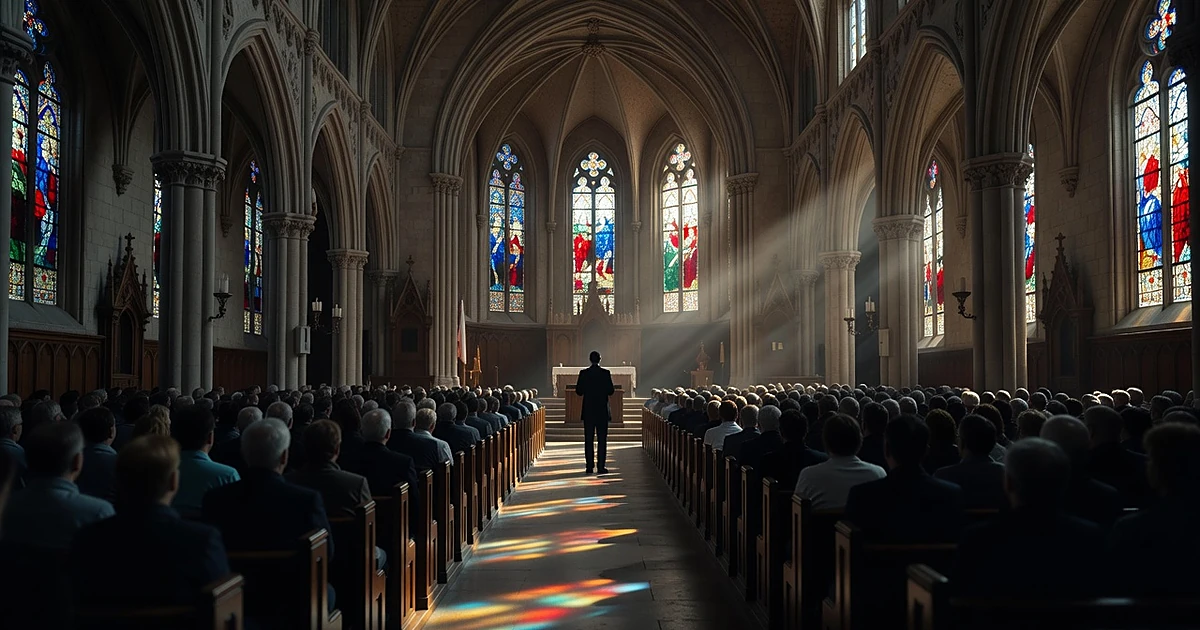
Davis pointed to the collapse of the institutions that once gave young men structure. Churches, volunteer organizations, recreational leagues, the social scaffolding that used to organize a young man's week and connect him to his community has largely disappeared. Davis described the result as a "deinstitutionalization" that has left the social world "more formless."
Without those anchors, young men are left to build relationships and identity on their own. The survey suggests many of them are not succeeding. Davis wrote that real wages for young men have stagnated in recent decades, and that the economy no longer rewards steady employment the way it once did.
The former president's enduring cultural presence, from podcast appearances to public events, may help explain why 54 percent of the young men surveyed named Barack Obama as a celebrity role model, tying him with LeBron James. Only 46 percent said they looked up to a religious leader. That gap tells a story about where young men are searching for guidance and what kind of authority still commands their respect.
Another 31 percent said they looked up to Andrew Tate, the controversial internet personality. Davis called that figure "worrying." Whether or not one shares that judgment, the number reflects a vacuum: when churches, coaches, and fathers are absent, young men will find someone to follow.
Daily gambling, daily pornography, and a 12 percent incarceration rate
The behavioral data in the survey is stark. Twenty-three percent of the young men reported gambling every day. Twenty-seven percent said they watch pornography daily. Davis described these not as moral failings in isolation but as coping mechanisms, habits young men adopt when they lack purpose, structure, and community.
Davis wrote plainly about the pattern:
"Although these are self-destructive activities, young men are turning to them as a coping mechanism."
Twelve percent of the respondents said they had been incarcerated at some point. For a survey of young men, not middle-aged or older adults with decades of exposure to the criminal-justice system, that figure is extraordinary. It means that in a room of twenty young men, at least two have spent time behind bars.
The education system, Davis argued, remains one of the few institutions that still provides measurable structure and upward mobility. He noted that the "formal-education track" is the last remaining pathway with real institutional strength. But he immediately qualified the point: many young men cannot access higher education, whether because of cost, family obligations, or fear of failure.
Obama himself remains a polarizing figure well beyond the survey data. His presidential legacy continues to generate controversy, including payment disputes exceeding $1.4 million at the Obama Presidential Center and ongoing debates about the consequences of policies enacted during his administration.
Young men want families but can't find the path forward
Perhaps the most striking tension in the survey is between aspiration and paralysis. Davis reported that most young men hold "worthy goals, including marriage, children and financial independence." They value belonging, relationships, and respect. They are not, by and large, nihilists. They are not checked out of the idea of a good life. They simply cannot locate the on-ramp.
Davis described the condition as liminal, suspended between two states:
"Many young men are in a liminal position. On the one hand, they have a sense for what a full life might look like, complete with a loving and productive family. On the other hand, they are not living that life or even moving toward that goal, and this paralysis is a source of immense distress."
That distress is the thread running through every data point. The daily gambling, the pornography consumption, the sense of powerlessness, the incarceration, these are not separate problems. They are symptoms of a single condition: young men who know what they want and cannot figure out how to get it, in a society that has dismantled the institutions that once showed them the way.
Critics of Obama-era governance have long argued that his administration's policy choices, including immigration enforcement decisions that led to tragic consequences, contributed to the erosion of the social fabric Davis describes. Whether or not one draws a direct line, the institutional decay the survey documents did not happen overnight.
Seventy-nine percent of the young men said they looked up to their mothers. Sixty-nine percent cited their fathers. Those numbers confirm something conservatives have long argued: family remains the most powerful institution in a young person's life. But the gap, ten percentage points between mothers and fathers, also reflects the reality that too many fathers are not present to be looked up to.
Davis rejects the 'deficient men' narrative
One of the most pointed arguments in Davis's commentary is his rejection of the idea that struggling young men are simply lazy or broken. He pushed back directly against that framing:
"So dismissing these men as simply deficient misses the broader point: These young men want to transcend their circumstances, but can't locate the path to do so."
He went further, suggesting that the withdrawal so many young men exhibit may not be a personal failure at all but a reflection of a society that has stopped doing its job. Davis closed his commentary with a challenge aimed squarely at the culture:
"Withdrawing may not be a failure of manhood. It may be a symptom of our collective impoverishment, which asks young men for something that our society no longer helps provide."
That framing is worth sitting with. The survey did not find a generation of men who have given up on the idea of a meaningful life. It found a generation of men who have been cut loose from the institutions, families, churches, trade paths, civic organizations, that once made a meaningful life achievable. The public spectacles of elite family life that dominate media coverage bear little resemblance to the daily reality these young men face.
Davis and his colleagues at the Institute of Family Studies set out, in their words, "to hear what they have to say." What 2,000 young men said back should unsettle anyone who cares about the country's future: they want what previous generations had, they cannot find it, and they are coping in ways that make the problem worse.
A society that tears down every institution young men once relied on and then wonders why they are lost is not facing a mystery. It is facing a consequence.