House overwhelmingly passes bill forcing data centers to pay for their own grid upgrades
The House approved the Ratepayer Protection Act 417, 3 on Wednesday, a bipartisan bill that would stop utility companies from passing data-center power costs on to families and small businesses.
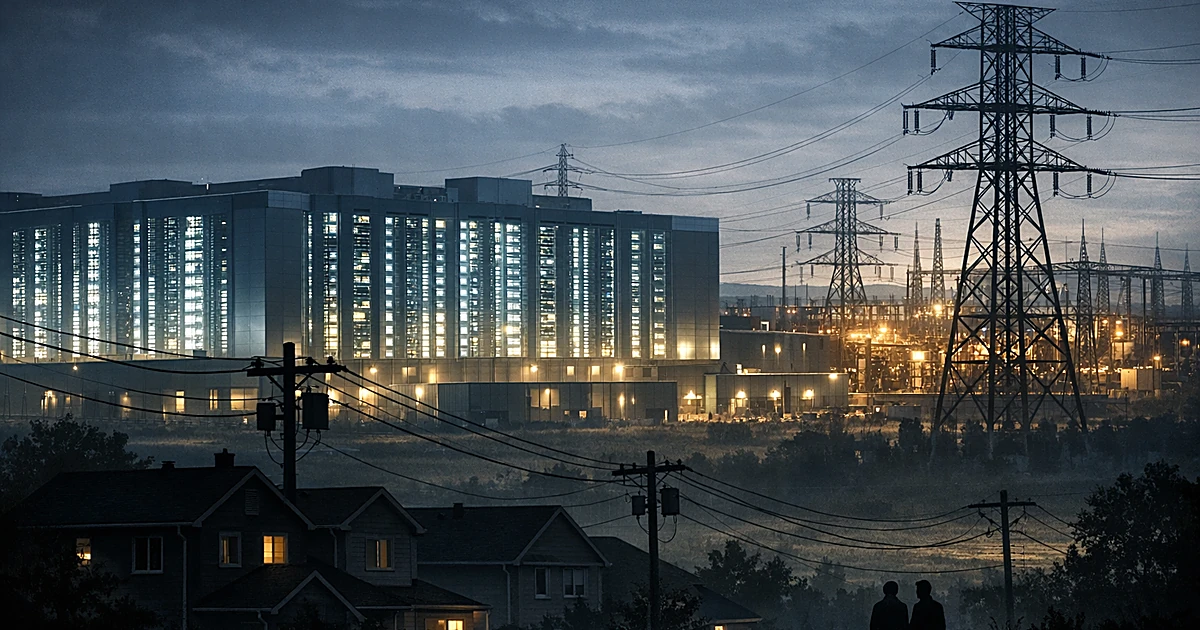
The lopsided vote sent a clear message: nearly every member of Congress agrees that the explosive growth of artificial-intelligence data centers should not stick ordinary households with higher electric bills. The legislation, if the Senate takes it up, would amend federal energy law to require any data center drawing 100 megawatts or more to cover the full cost of generation, transmission, and distribution upgrades built to serve it.
Rep. Gabe Evans, a Colorado Republican, and Rep. Kathy Castor, a Florida Democrat, introduced the bill. That pairing, a freshman conservative from a swing district and a veteran progressive from Tampa, signals how far the concern over data-center energy costs has spread across the political map. The Washington Examiner reported that the measure aims to allay rising voter fears about the data-center industry's appetite for electricity.
Only three House members voted no, all progressives
Every Republican present voted yes. So did all but three Democrats. The dissenters were Reps. Rashida Tlaib of Michigan, Summer Lee of Pennsylvania, and Delia Ramirez of Illinois, Breitbart reported. None of the three has been quoted explaining the vote in the available record.
That a bill protecting ratepayers from corporate cost-shifting drew opposition only from the progressive flank is worth noting. The same members who routinely demand that corporations "pay their fair share" balked at a measure that does exactly that for energy infrastructure. Their reasons remain unclear, but the vote is on the record.
The near-unanimity stands out in a Congress that struggles to find bipartisan ground on much of anything. When 417 members agree, the underlying problem is usually too obvious to spin.
Evans frames the bill around families, not against tech
Evans, the bill's Republican co-sponsor, cast the legislation as pro-innovation and pro-family at the same time. He told reporters:
"As America races to lead the world in AI, we must build the energy infrastructure needed to support this innovation and stay ahead of competitors like communist China. But Colorado families, farmers and small businesses should not be forced to cover the costs of new power generation driven by these developments."
That framing matters. The bill does not block data-center construction or slow AI development. It simply says the companies profiting from those facilities, some of the wealthiest corporations on earth, must pay for the power infrastructure they require. Evans added in a separate statement that "large load data centers must cover the full costs of any system updates they require, not families or small businesses."
Castor, the Democratic co-sponsor, put the emphasis on pocketbook pain already hitting her constituents. Fox News reported her remarks:
"My neighbors across Florida are grappling with skyrocketing electric bills. Ratepayers should not have to subsidize wealthy corporations' growing energy demands, especially from AI data centers."
When a Republican from Colorado and a Democrat from Florida use nearly identical language about protecting ratepayers, the political incentives are plain. Voters in both parties are watching their utility bills climb, and they want to know who is responsible.
Data centers consuming 100 megawatts trigger the requirement
The bill sets a clear threshold. Any data center consuming 100 megawatts or more, roughly enough electricity to power 80,000 homes, would be required to pay the full cost of grid upgrades built to serve it. That includes generation capacity, transmission lines, and local distribution infrastructure.
The legislation also requires companies to make financial assurances in case a project is canceled. That provision addresses a growing worry in communities that have approved data-center construction: if the company pulls out or scales back, local ratepayers could be left holding the bill for infrastructure nobody else needs.
Congress has been increasingly focused on Big Tech's footprint across multiple policy areas, from antitrust to content moderation. Energy consumption is the newest front, and it may be the one where left and right find the most overlap, because the cost lands directly on household utility bills, not on abstract market metrics.
House Majority Leader Steve Scalise endorsed the approach in straightforward terms:
"As we're advancing in technology, we've got to do it the right way. Let locals make the choice, and let consumers reap the benefits."
Senate timeline is tight with midterms approaching
The bill now moves to the Senate, where its path is far less certain. Senate Majority Leader John Thune has acknowledged the compressed schedule. Breitbart reported that Thune said moving quickly would require a consent agreement among senators, a procedural shortcut that any single member can block.
With roughly three weeks of legislative session remaining before the midterm elections, the window is narrow. Senators facing competitive races may want to cast a vote protecting ratepayers. But the Senate's calendar is already crowded, and data-center lobbyists will have time to work the upper chamber in ways they clearly could not in the House.
The broader economic anxiety gripping the country gives the bill political tailwind. Voters already squeezed by inflation and rising costs are unlikely to accept the argument that trillion-dollar tech companies need ratepayer subsidies to keep the lights on in their server farms.
No industry opposition statements have surfaced in the available reporting, though the lobbying effort is almost certainly underway. Data-center operators and the tech giants that lease their capacity have enormous resources and strong relationships on Capitol Hill. Whether those relationships can overcome a 417, 3 House vote remains to be seen.
The bill's structure, requiring states to consider a federal standard rather than imposing a single national mandate, gives it a federalist flavor that should appeal to conservative lawmakers wary of top-down regulation. It sets the principle that large power consumers pay their own way, then lets state utility commissions work out the details. That approach echoes the kind of local-control framework that Republicans have long championed in other policy areas.
A rare case where the principle is simple
Strip away the policy jargon and the Ratepayer Protection Act rests on a principle most Americans learned before they finished grade school: you pay for what you use. If a data center needs a new substation, a bigger transmission line, or an additional power plant to keep its servers humming, the company behind that data center, not the retiree down the road, should cover the tab.
The 417, 3 vote suggests Congress, for once, agrees. The question now is whether the Senate will act before the midterms or let the bill sit while households keep absorbing costs that belong on a corporate balance sheet.