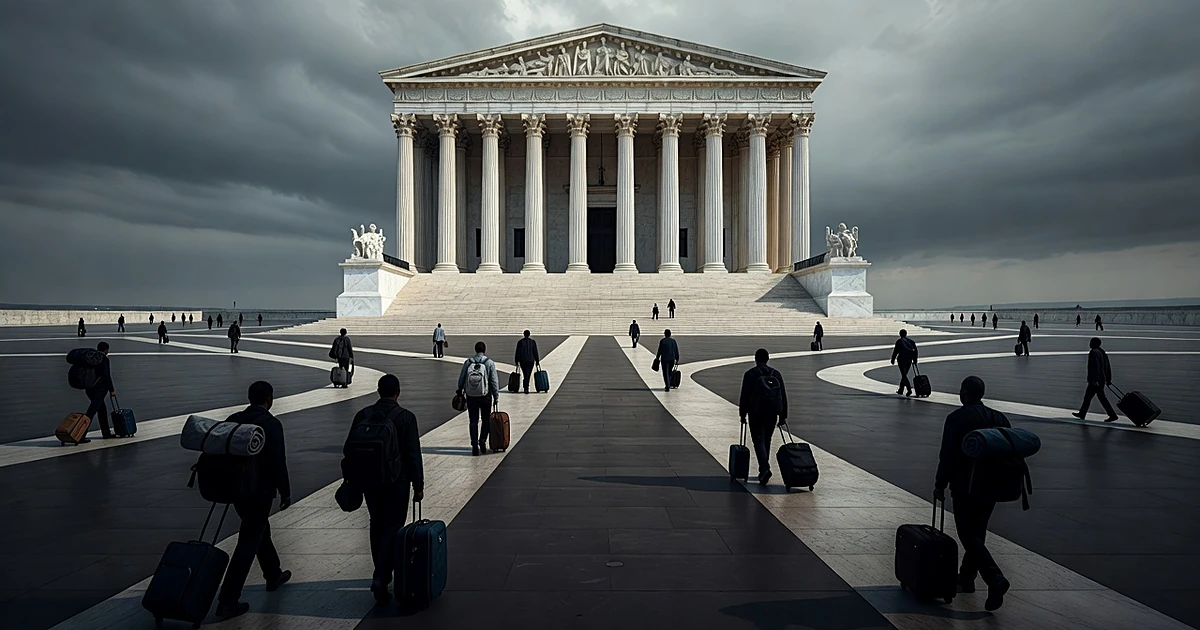
Supreme Court clears Trump to resume third-country deportations of illegal immigrants
The Supreme Court has allowed the Trump administration to resume deporting illegal immigrants to third countries without added fear hearings, siding with the Justice Department over a Boston judge’s block.
In a 6-3 order on Tuesday, the justices granted the Justice Department’s emergency request and put on hold U.S. District Judge Brian Murphy’s ruling that the Department of Homeland Security policy was unlawful. Removals to countries other than a migrant’s own may restart at once. The court also set arguments for December, with a full decision to follow later.
The stay restores a tool the administration calls central to its immigration crackdown. Officials say many people with final removal orders cannot be sent back to the nations listed on those orders, so third-country options keep the process moving.
Justice Department lawyers told the high court the practice is “an essential tool to remove certain aliens, including some of the worst criminal aliens.” That framing matches the White House push for large-scale removals since President Donald Trump returned to office.
Department of Homeland Security General Counsel James Percival welcomed the result on social media, writing, “A bad day for criminal illegals and open-borders activists alike.”
White House spokeswoman Lauren Bis struck a similar note after the order, saying the President will stop at nothing to make America safe again and that the ruling affirms the lawfulness of his homeland security agenda. Fox News carried the statement alongside the administration’s broader case for the policy.
The same legal fight earlier saw the Trump administration ask the Supreme Court to restore the third-country deportation policy after an appeals court stepped in, underscoring how often lower-court blocks have forced emergency trips to Washington.
Murphy, sitting in Boston, ruled in February that the DHS approach violates immigration-law procedures and due-process protections under the Fifth Amendment. Due process generally requires notice and a chance to be heard before certain adverse government actions. On September 18 the Boston-based 1st U.S. Circuit Court of Appeals upheld most of that decision.
Immigrant-rights groups brought the class-action case on behalf of migrants. Their lawyer, Trina Realmuto of the National Immigration Litigation Alliance, said the high court “allowed the administration to resume sending people to third countries where they face persecution or torture. That is a devastating result for people who may be put on a plane before they ever have notice or an opportunity to raise a fear claim.”
Plaintiffs told the courts the policy has left some deportees “unlawfully transferred by third countries back to their home countries from which the US had already granted them protection, while others have been beaten, sexually assaulted, detained or have disappeared.” They also accused the administration of ignoring “the significant harm resulting from deporting thousands of longtime US residents, many with no criminal history, to third countries without regard to the persecution or torture they face there.”
Murphy found the administration “repeatedly violated, or attempted to violate” his earlier orders. In 2025 he separately concluded officials had breached another directive that required extra steps before a group of migrants could be sent to South Sudan.
Three liberal justices dissented from the decision to let the removals resume while the case continues. The court’s conservative majority has already sided with the administration twice in the same litigation, once by suspending an earlier Murphy halt on removals and later by lifting limits the judge had placed around a South Sudan flight.
The Washington Examiner noted the 6-3 posture lets the government keep deporting illegal immigrants who already carry final removal orders to third countries for now, with oral arguments locked in for December.
That timeline keeps pressure on a single district judge’s attempt to rewrite removal rules nationwide, a pattern that has drawn sharp pushback from the right. The Supreme Court has also weighed other Trump administration election-policy disputes in recent months, showing how often major enforcement and process fights land on the same docket.
How the third-country policy actually works
Under the DHS framework, migrants can be moved quickly to a third country that has given credible diplomatic assurance it will not persecute or torture them, often without advance notice. When no such assurance exists, authorities notify the person of the destination and review persecution or torture fears only if the individual raises them.
The administration’s filing stressed the foreign-policy stakes: “The order below also undermines our standing abroad... Finding third countries willing and able to accept aliens is a delicate diplomatic endeavor.” Sensitive talks with receiving nations continue while the stay remains in place.
Human-rights groups tally more than 25,000 migrants sent to 29 countries under the policy implemented last year. The vast majority went to Mexico. Other destinations have included South Sudan, Uganda, Equatorial Guinea, Liberia, and the Central African Republic. The State Department separately urges Americans to avoid South Sudan because of crime, kidnapping, and armed conflict.
The case itself opened in 2025 after DHS moved to accelerate removals of people who could not be returned to any country listed on their deportation orders. That practical bottleneck is exactly why the administration treats third-country options as indispensable.
National Review’s Andrew C. McCarthy described the latest order as a blunt message to the bench: the Supreme Court has instructed a Biden-appointed federal district judge in Boston that it meant what it said when it vacated his attempt to write new immigration law under the guise of an injunction against Trump administration deportation of criminal aliens to “third countries.” National Review emphasized that Congress’s immigration statutes unambiguously control these removals and that “third countries” means nations to which the aliens have no prior ties of citizenship, nationality, birthright, residence, or travel and have not requested deportation.
Those statutory lines matter. One district judge in Boston does not get to redesign the removal system for the entire country while criminal aliens and other removable aliens sit in limbo.
Political resistance to Trump’s broader agenda has taken other forms as well. A lame-duck Democrat recently unveiled two dozen impeachment articles aimed at the president ahead of the midterms, illustrating the parallel track of lawfare and legislative attacks that enforcement efforts must navigate.
December arguments will test the full policy
The justices will hear the dispute in December and then issue a formal ruling on whether the third-country framework stands. Until then the stay keeps the flights available. Officials can again match final-order cases with countries willing to accept the individuals, including those the administration identifies as high-priority criminal aliens.
Murphy’s February order had layered extra notice and protection-claim procedures onto every such removal. The Supreme Court has now paused that overlay. The practical effect is immediate: DHS regains speed and flexibility while diplomats finish arrangements with partner nations.
Prior emergency interventions in the same lawsuit already signaled where the majority stands. Each time the district court tried to halt or condition the removals, the high court stepped in for the executive. Tuesday’s order continues that pattern and rejects the idea that one judge’s due-process gloss can freeze a Congressionally authorized tool.
Other recent high-court fights show the same institutional tension. The Supreme Court again blocked a Missouri GOP congressional map in a separate redistricting clash, proving the justices remain willing to police lower-court and state-level overreach when the legal lines are clear.
For front-line agents and taxpayers who have watched repeat crossers and criminal aliens cycle through the system, the stay returns a concrete option that lower courts had taken away. The December hearing will decide the long-term rules. The interim reality is simpler: third-country deportations are back on.
The administration’s wider enforcement record keeps drawing legal challenges, yet the Supreme Court majority has now restored this particular removal authority while the full case proceeds.
Voters asked for secure borders and actual removals, not endless injunctions from a single courtroom in Boston. The high court just gave the executive the room to deliver.