President Trump says New York Times and other outlets should be arrested over Ohio rally coverage
President Trump said Monday that The New York Times and other media outlets should be arrested for dishonest coverage of his Ohio rally, rejecting empty-seat claims and defending a packed house.
President Trump went on Truth Social after his Saturday appearance in Vandalia, Ohio, and accused major newsrooms of shortchanging the crowd and shortchanging the country. He said reporters from The New York Times and other outlets should face arrest for what he called dishonesty and a disservice to the nation.
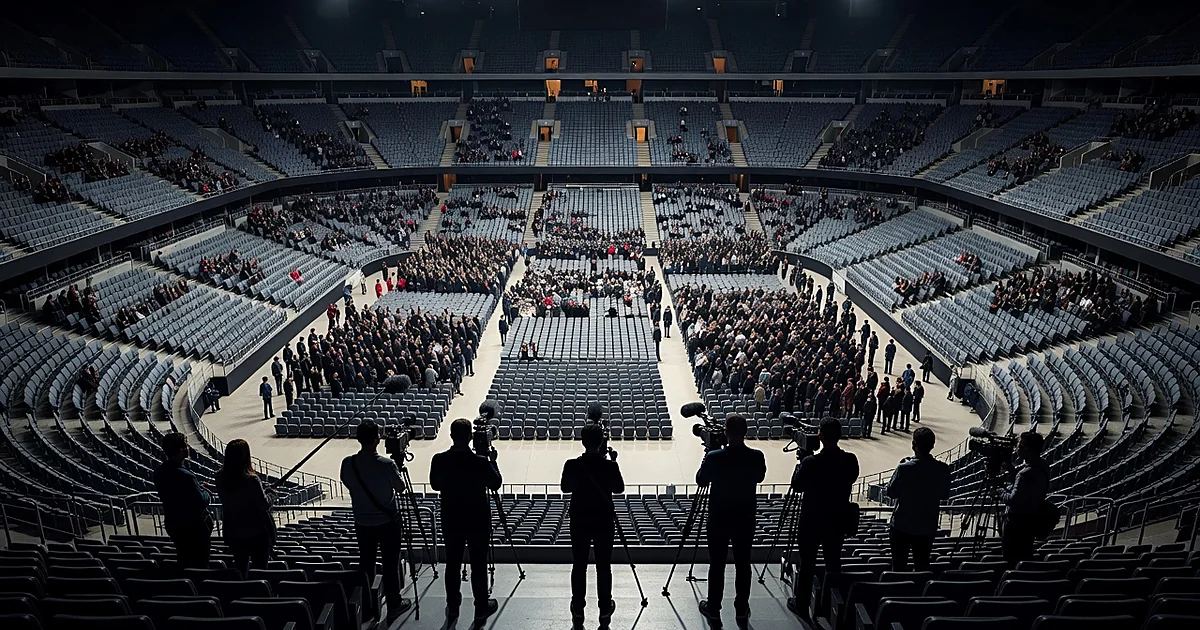
The Hill reported that the president was answering a Sunday New York Times account of the rally at Butler High School’s student center, where correspondent Katie Rogers wrote that several areas of an upper deck sat empty by the time he finished speaking and noted the venue’s 4,500-person capacity.
Trump rejected that picture outright. He posted that the arena was already full and that people were still trying to get in, then followed with a sharper demand aimed at the press.
"The New York Times, and many other Artificial Media Outlets, should be arrested for their dishonesty and disservice to our Country,"
That line sat beside his insistence the house was maxed out from floor to upper sections. He argued the familiar pattern at his events: fans in the upper seats drift down to the main floor, which can leave gaps that cameras and critics treat as proof of a thin turnout.
Trump posts video and says thousands were turned away
On Truth Social he shared video of the line outside and of his entrance as the crowd chanted “USA.” He wrote that the Ohio arena was already full to the brim even as more people tried to enter.
"The Arena was totally MAXED OUT, including all upper sections,"
He added that the “migration” from upper sections to the floor “always happens” at his sold-out rallies. At the event itself he told the room thousands remained outside who could not get in, and he even offered a wry seat trade if anyone wanted to leave.
"There are thousands of people outside [who] can’t get in. If you’d like to give up your seat, please, we can work it out, get out of here,"
The dispute is familiar. Crowd size has long been a proxy fight over momentum, legitimacy, and whether national outlets describe conservative turnout honestly or sand it down. Trump tied the Ohio coverage to a broader charge: that the same shops inflate crowds for figures such as Sen. Bernie Sanders while downplaying his.
Husted gets the stump speech in a pivotal Ohio race
The Saturday stop was not only a crowd argument. Trump was there to boost Sen. Jon Husted, the Ohio Republican facing a reelection fight against former Sen. Sherrod Brown. Former NFL coach Jon Gruden spoke too and called Husted a friend who “will never quit.”
For voters watching the midterms, the visuals matter. A full student center in Vandalia, people turned away, and a president willing to say the quiet part about press incentives lands differently than a story framed around empty upper-deck pockets. Readers can weigh Rogers’ empty-seat description against the president’s videos, his floor speech, and his claim of turnaways.
Accountability talk from Trump is not limited to newsrooms. He has also pressed Congress for mandatory prison time on Medicare, Medicaid, and Social Security fraud, treating large-scale wrongdoing as a matter for real penalties rather than shrugs.
Years of friction with the Times, and a summer subpoena fight
Trump has targeted The New York Times since his first presidential campaign, casting unfavorable coverage as a pattern rather than a one-off. The arrest language this week fits that long-running clash over how his events and his record get framed.
Background in the same reporting shows how raw the institutional fight can get. Over the summer the Justice Department subpoenaed phone records of multiple Times journalists and family members after stories on Secret Service concerns about a Qatari-gifted jet linked to Air Force One. The department dropped the request days later.
Separate court fights continue to define the broader climate around executive power and appointments, including a case where a Seattle judge reinstated a fired U.S. attorney and limited removal of a court appointee.
None of that summer subpoena episode produced the arrests Trump is now calling for over rally coverage. No arrests, injuries, or closures from the Ohio dispute itself appear in the account, only the president’s public demand, the Times seating description, and the competing claims about how full the Butler High School student center actually was.
Empty seats, full floor, and who gets believed
Strip the spin and the verified conflict is narrow and concrete. A Times correspondent reported empty upper-deck areas by the end of the speech and a 4,500 capacity. The president posted that every section was maxed out, that migration to the floor is normal, that thousands stood outside, and that outlets misled the public. He backed the point with line video and entrance video as chants rolled through the room.
That is the choice readers face. Either the upper-deck gaps were the real story, or they were the predictable leftover of a packed main floor and a press corps quick to narrate decline. Trump’s answer was blunt: treat systematic misreporting as more than a style difference.
Criminal justice arguments elsewhere show the same appetite for finality over endless process, whether in debates over a Texas judge upholding a murder conviction or other high-stakes punishment cases.
Trump has also weighed in when the machinery of punishment fails in plain view, as when he questioned Tennessee after a botched lethal injection left a murderer alive. The through line is simple: when institutions falter or shade the truth, he names it and asks for consequences.
Federal courts have pushed back on other administration moves, including a second judge blocking a $100,000 H-1B visa fee, but the Ohio fight is not a fee rule or a personnel order. It is a president telling the country the crowd was real and the coverage was not.
Press power without press humility becomes just another faction with a megaphone. Voters in Ohio and beyond can watch the tape, read the seating claim, and decide whose version matches what they see.