Catholic exorcist describes demonic encounter he says confirmed the reality of evil
Father Carlos Martins, a Canadian-born Catholic priest who has performed exorcisms around the world, said on his podcast that the psychological manipulation he witnessed during exorcisms was far more disturbing than any physical phenomenon, and that a recurring demonic entity he first encountered as an atheist followed him into the priesthood.
Martins, who converted to Christianity in the mid-1990s after years as an avowed atheist, described on his podcast, The Exorcist Files, a series of experiences he said began before he ever considered entering the seminary. The entity, he claimed, called itself "Confusion", and it reappeared at a pivotal moment during his first exorcism as a seminarian.
The account raises questions that a secular culture rarely takes seriously. But for millions of Christians who believe in the reality of spiritual warfare, Martins' testimony lands differently. And in a cultural moment when interest in the occult appears to be growing, and the Catholic Church itself is responding, his claims deserve a fair hearing on their own terms.
From atheism to the exorcism room
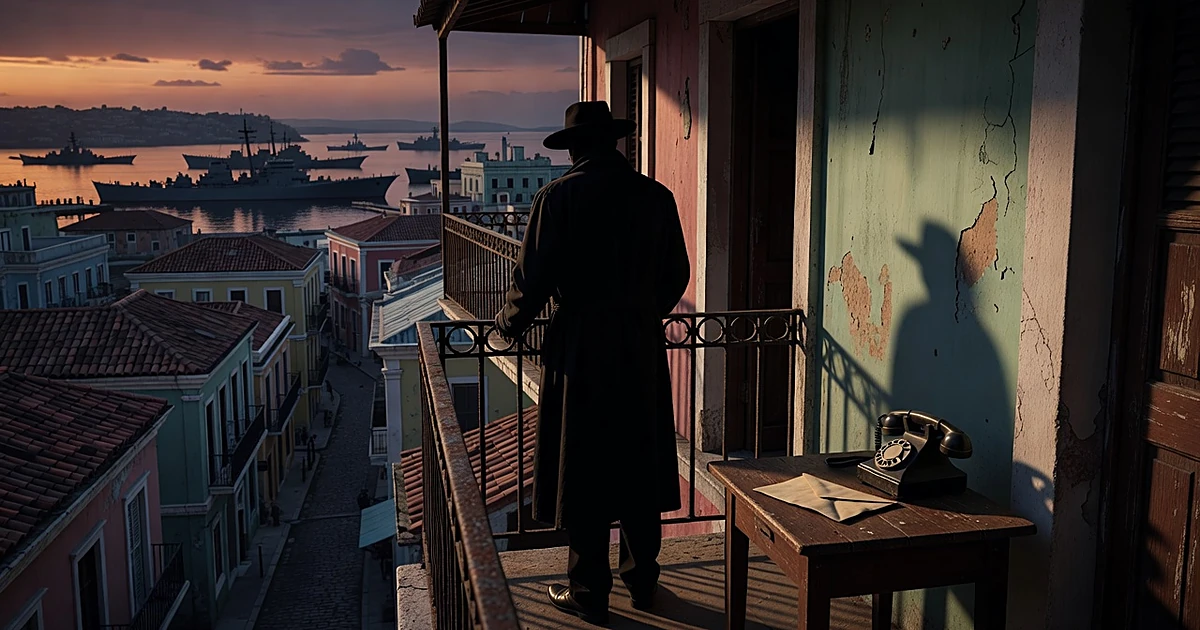
Martins was ordained in 2009, but his path to the priesthood was anything but conventional. He spent his young adulthood as an atheist. During that period, he said, he began experiencing what he described as demonic harassment, encounters he did not seek out and could not explain within his materialist worldview.
He did not specify when or where the first encounter occurred. But he said the experience was decisive.
"It just became obvious that the devil is real, and when I encountered the devil for the first time, none of that was a surprise."
Martins said he came to believe that "the truth of reality was contained within the Christian understanding of the cosmos." He converted to Christianity in the mid-1990s and eventually heard the call to the priesthood.
Years later, as a seminarian observing his first exorcism, Martins said the same entity resurfaced. The demon, he claimed, addressed him directly with a phrase that connected his past to his present: "You were supposed to be one of us."
That moment, Martins said, brought everything into focus. The harassment he had experienced as an atheist, the entity's persistence, its knowledge of his personal history, all of it pointed, in his telling, to a spiritual reality operating behind the scenes of ordinary life.
"In that moment, there was just an awareness. I remember looking up and stepping aside. Everything made sense. I myself was harassed by this demon during my atheism."
The mind of the devil
What sets Martins' account apart from the Hollywood version of exorcism is his insistence that the physical spectacles, levitating chairs, bodies lifting off the ground, are the least important part of what happens in the room. He said he witnessed such things in his earliest exorcisms, but they became routine.
"If you walk into a room and you know, for the first time, and there's a chair levitating, it's going to make the hair on the back of your head stand up. What about the 18th time you see that? What about the 89th time you see it? You're going to care less and less and less each time."
Martins explained that demonic entities use physical phenomena as intimidation, especially when someone new is present. A "fresh audience," he said, gives the entity a reason to perform. But for a seasoned exorcist, the real danger lies elsewhere.
The psychological manipulation, Martins said, is what genuinely frightens him. The way a demon studies a person. The way it exploits weakness. The way it tailors temptation with surgical precision.
"Even the stuff that he did to his victims didn't faze me as horrific as it was. What was much more fearsome than the physical phenomena that you see in the room, what you see, what you hear, what you feel in the room, is the mind of the devil, the evil he's capable of, the mind games he will play."
The broader cultural conversation around spiritual evil has intensified in recent months. Pope Leo XIV recently convened an exorcist delegation at the Vatican amid what has been described as a global rise in occultism, a development that suggests the institutional Church is taking these matters more seriously than it has in decades.
How demons operate, in Martins' telling
Martins offered a detailed account of what he said he has learned through years of performing exorcisms worldwide. Central to his claims is the idea that demonic entities engage in long-term surveillance of their targets.
"The devil has spent your whole life perceiving you, watching you, taking notes."
The purpose, he said, is to craft temptations that are uniquely effective for each individual. He put it bluntly: "If it's redheads, you like, he's got the perfect redhead. If it's money, if it's power, if it's an opportunity, he will offer those."
Martins also described how demons guard their identities. In exorcism, identifying the entity by name is considered a critical step. But Martins said demons almost never give their real names voluntarily.
"Normally, a demon hides its name, and if you wear them down enough and he concedes to give you a name, 99 times out of 100 it's not his real name. He gives you something fake."
The entity Martins said he encountered repeatedly, "Confusion", behaved in ways consistent with its chosen name. Martins described how the demon would shift tone mid-conversation, saying things designed to throw him off balance.
"He would stop all of a sudden and just say, 'I'm beginning to dislike you less and less.' It throws you off. He hopes that his very identity, the identity expressed in his name, he's able to cause confusion."
Martins also said demons reference private moments from a person's past, events with no witnesses, as a way of asserting dominance. "Devils will refer to different parts of my life, and to events that only I would know, events that had no witnesses there, just as a way to tell me, 'I know you, and we've been watching you,'" he said.
Why the spectacle fades
One of the more striking claims Martins made on The Exorcist Files is that demonic physical displays diminish over time, not because the entities grow weaker, but because intimidation loses its value against an experienced exorcist.
"Why would you see levitation earlier in your career as an exorcist than later? Well, because the devil is doing that to try to intimidate you, to try to get you to walk away, and to think, 'This is just too crazy. This is too weird. It's too scary.'"
Martins said the entity's "energy level is not infinite," suggesting that demonic forces allocate their efforts strategically. When a newcomer enters the exorcism room, the spectacle returns. "If I have somebody new in the room during an exorcism, then I can expect to see stuff like that, because now he's got a fresh audience now," he said.
The implication, in Martins' framework, is that evil is not chaotic. It is calculated. It adapts. It conserves energy for maximum effect. Whether one accepts his claims at face value or not, the internal logic he describes is coherent, and it challenges the popular assumption that belief in demonic activity belongs to a pre-scientific age.
That assumption has been tested by real-world events. The case of a Shreveport father who reportedly spoke of "demons" before a horrific act of violence is a reminder that the language of spiritual evil still surfaces in the darkest corners of American life, often dismissed by institutions that have no framework for addressing it.
A story the modern world doesn't want to hear
Martins' account is, by its nature, unverifiable in the way a court filing or a government report can be verified. There are no primary documents, church records, or audio transcripts cited alongside his claims. The podcast episode's air date is not specified. The locations of his encounters are not named.
These gaps matter. Readers should weigh them honestly.
But it is also worth noting what Martins is not doing. He is not selling a product. He is not running for office. He is a Catholic priest, ordained in 2009, who describes experiences that began when he was an atheist, before he had any institutional reason to claim them. His conversion in the mid-1990s preceded his ordination by more than a decade. The timeline does not suggest a man who adopted a belief system and then manufactured evidence to support it. It suggests the reverse.
The modern secular establishment treats claims like Martins' as curiosities at best, symptoms of delusion at worst. But the Christian tradition, and a growing number of people within the Catholic Church, takes them seriously. The faith that built Western civilization was never embarrassed by the existence of evil. It named it, confronted it, and built institutions to fight it.
Artifacts of that ancient confrontation still turn up in unexpected places. Rare "Lamb of God" coins unearthed in Denmark bear witness to a thousand-year-old understanding that spiritual protection was not a metaphor, it was a daily necessity.
Father Martins would say it still is.
A culture that refuses to believe in the reality of evil will have no defense when it shows up. And if Martins is right about even half of what he describes, it has been showing up for a long time.