The Vatican calls media reports about hostile Pentagon meeting 'completely untrue'
The Holy See took the unusual step Friday of publicly denying press accounts that depicted a January meeting between a senior Vatican diplomat and a Trump administration defense official as a hostile confrontation, calling the narrative spun by several outlets "completely untrue."
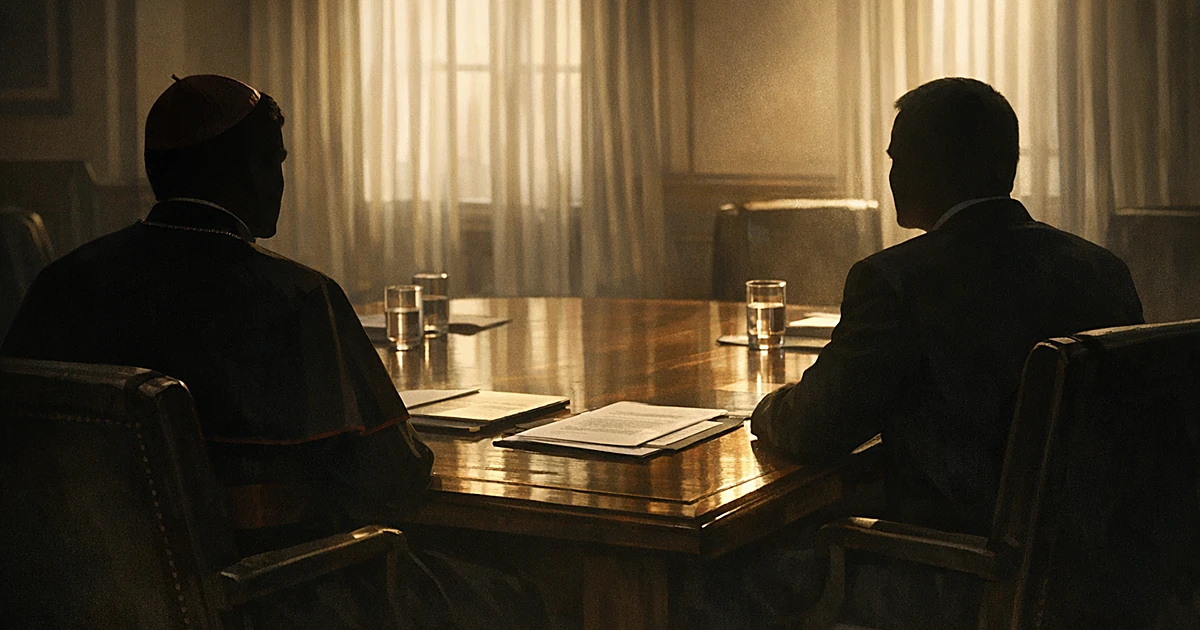
Matteo Bruni, director of the Holy See Press Office, confirmed that Cardinal Christophe Pierre, then the Vatican's ambassador to Washington, did meet with Elbridge Colby, the Under Secretary of War for Policy, in January. But Bruni's statement, released in Italian, described the sit-down as "part of the regular mission of the Papal Representative and provided the opportunity for an exchange of views on matters of mutual interest."
The statement then delivered its sharpest line: "The narrative offered by some media outlets regarding this meeting is completely untrue."
That rare public rebuke from the Vatican was aimed squarely at a week of escalating media claims, claims that both the Holy See and the U.S. government now say were fabricated or grossly distorted. The episode is a case study in how a single thinly sourced report can cascade through newsrooms and social-media platforms until the people who were actually in the room are forced to step forward and say it never happened the way it was told.
How the story unraveled in five days
The chain began Monday, when The Free Press published a report alleging that the Trump administration had sought to strongarm the Vatican into supporting its position on the war with Iran. The report described the January Pierre-Colby meeting as intense and confrontational.
By Wednesday, Christopher Hale, a Democratic National Convention delegate who writes a publication called Letters from Leo, was amplifying the claims. Hale said he could "independently confirm The Free Press report that the meeting took place, and that some Vatican officials were so alarmed by the Pentagon's tactics that they shelved plans for Pope Leo XIV to visit the United States later this year."
Hale went further, alleging that other Vatican officials interpreted a reference to an Avignon papacy during the meeting as "a threat to use military force against the Holy See." He later told the Daily Caller that "five news outlets have independently confirmed the Free Press's report that the meeting was contentious."
But on the same day Hale was making those claims, JD Flynn, editor of The Pillar, one of the most respected Catholic news outlets in the country, pushed back publicly. Flynn wrote on X that "your pals down at the Pillar haven't confirmed this report."
Vice President JD Vance, a Catholic, was asked about the report by a journalist. He said he had not seen it, wanted to speak with Cardinal Pierre directly, and called the claims "unconfirmed and uncorroborated." He declined to offer an opinion.
Pentagon and U.S. ambassador push back hard
On Thursday, the Department of War's Rapid Response team posted a statement on X calling the January meeting "substantive, respectful, and professional" and saying "both sides looked forward to continued open and respectful dialogue." The statement added a sharper edge: "In light of grossly false and distorted recent reporting, the Department of War repeats its statement: Recent reporting of the meeting is highly exaggerated and distorted."
The Washington Examiner reported that the War Department called the accounts "grossly false," "highly exaggerated," and "distorted," while the U.S. Embassy to the Holy See relayed Cardinal Pierre's own description of the reports as "fabrications."
Also on Thursday, Brian Burch, the U.S. ambassador to the Holy See, said he had spoken directly with Cardinal Pierre. Burch relayed on X that Pierre confirmed the media characterizations of his meeting with Colby were "fabrications" that were "just invented." Pierre described it as a "frank and cordial meeting."
Breitbart reported that Burch and the U.S. Embassy to the Holy See said Pierre described the January sit-down as a normal, cordial encounter and that the reported threat scenario simply did not happen. Burch was unequivocal in his account of what Pierre told him.
That left the Vatican's own Friday statement as the capstone: a formal, on-the-record denial from the Holy See Press Office itself, not filtered through an ambassador or a Pentagon spokesman, but issued directly from Bruni's office in a communication to journalists.
The sourcing gap behind the media firestorm
What stands out in the wreckage of this story is how thin the original sourcing appears to have been, and how quickly partisan actors inflated it. Hale, who amplified the claims most aggressively, is not a neutral observer. He is a Democratic National Convention delegate. His assertion that five outlets independently confirmed the report's contentious framing now sits against denials from the Vatican, the Pentagon, the U.S. ambassador, and the cardinal who was actually in the room.
Hale also claimed that "our sources corroborate what CBS News and Financial Times noted about the Avignon papacy being raised during the discussion." But neither the Vatican's statement nor Burch's account of his conversation with Pierre supports the claim that any such reference constituted a threat. Burch said Pierre told him directly there was no threat of Avignon in the meeting.
The tensions between Pope Leo XIV and the Trump administration on Iran policy are real and well-documented. Pope Leo has publicly criticized the administration's Iran rhetoric in strong terms, and the January State of the World address reportedly included language urging nations not to violate the borders of others, remarks some interpreted as aimed at the United States.
Francesco Sisci, cited by Newsmax, offered a more measured account. He suggested the discussion "might have gotten a bit intense" and that "somebody misspoke," but even that characterization falls far short of the media narrative about Pentagon officials threatening the Holy See.
The pope himself told diplomats that "war is back in vogue and the zeal for war is spreading", a clear signal of where Leo stands on the broader conflict. Leo has publicly appealed to the Trump administration for diplomatic off-ramps as the Iran situation has continued.
Real disagreements, fabricated drama
None of this means the U.S.-Vatican relationship is without friction. Genuine policy disagreements exist. Pope Leo XIV has charted an independent course on the Middle East, and Cardinal Pierre's replacement as Vatican ambassador to the United States, veteran diplomat Gabriele Caccia, signals that the Holy See takes the Washington posting seriously enough to send experienced hands.
But policy disagreement is not the same thing as a hostile confrontation. And a frank diplomatic meeting is not a threat of military force against the world's oldest institution. The gap between what apparently happened in January and what media outlets told their audiences this week is wide enough to drive a truck through.
The Vatican does not issue public denials lightly. The Holy See Press Office chose its words carefully: "completely untrue." Not "exaggerated." Not "taken out of context." Completely untrue. The Pentagon used similar language. The man who was actually in the room, Cardinal Pierre, called the reports fabrications that were "just invented."
Hale, for his part, continued to insist his sources were solid. He shared what the Daily Caller described as a list of accounts on X. But a DNC delegate's unnamed sources now stand against on-the-record denials from the Vatican, the U.S. government, and the cardinal himself.
The broader context of Pope Leo's peace advocacy in the Middle East makes it easy for reporters to assume the worst about any closed-door meeting between the Holy See and the Pentagon. Assumption, however, is not reporting.
Several open questions remain. The Vatican has not addressed Hale's specific claim that plans for a papal visit to the United States were shelved. The exact wording about Avignon, if any, that came up during the January meeting has not been disclosed by either side. And the Holy See has not yet provided an official English translation of Friday's statement, though the Daily Caller requested one.
What is clear is that both principals to the meeting and both governments have now said, on the record, that the story as told by The Free Press and amplified by partisan voices was wrong. When the Vatican and the Pentagon agree on something, it is worth paying attention.
The press spent a week building a narrative about a diplomatic crisis. It took the people who were actually there to remind everyone that a meeting happened, it was cordial, and the rest was invented. That ought to tell readers something, not about U.S.-Vatican relations, but about the outlets that got it wrong and the partisans who wanted them to.