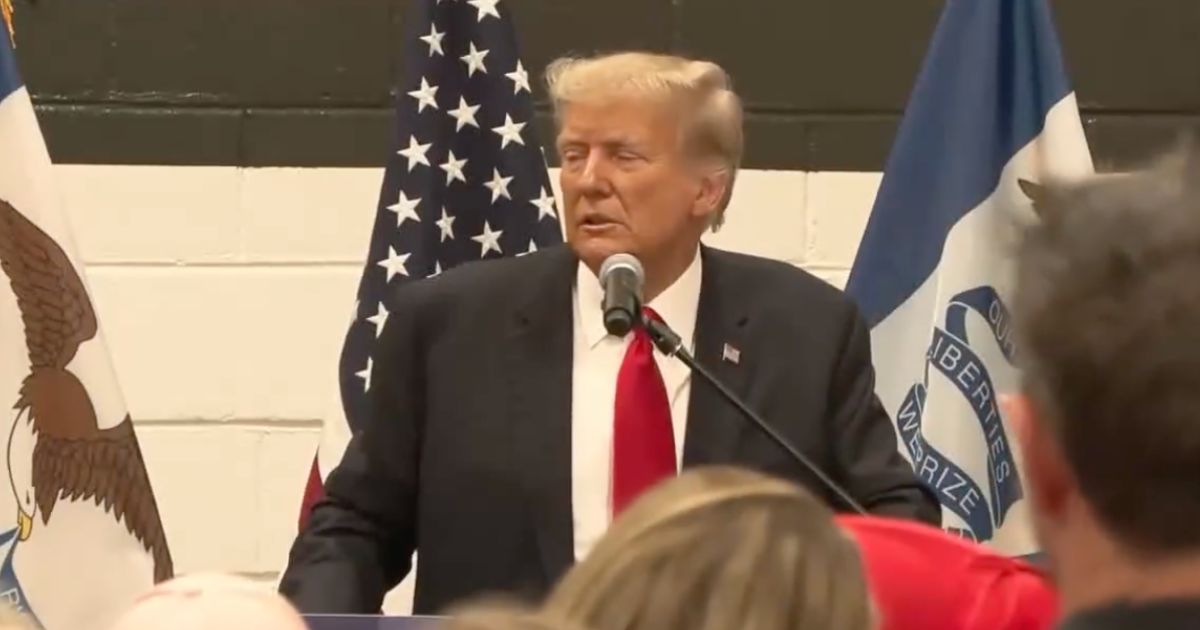
President Donald Trump used his sixth appearance at the National Prayer Breakfast to announce two concrete actions: a massive prayer gathering on the National Mall set for May 17, 2026, and new Department of Education guidance protecting the right of prayer in public schools.
The announcements came during the 74th annual National Prayer Breakfast in Washington, D.C., where Trump spoke with characteristic directness about faith's role in American life.
"To be a great nation...you have to have religion. You have to have it. You have to have faith. You have to have God."
That line alone would send half of Washington into convulsions. Which tells you more about Washington than it does about the statement.
A Rededication — Not a Suggestion
The May 17 event isn't a vague call for spiritual renewal. It's a specific date, a specific place, and a specific purpose. Trump framed it in terms that left no room for ambiguity:
"I'm pleased to announce that on May 17, 2026, we're inviting Americans from all across the country to come together on our National Mall to pray, to give thanks, and...we are going to do something that everyone said, like, that's tough. We're going to rededicate America as one nation under God."
According to
CBN, the timing is deliberate. With the nation approaching its 250th anniversary, the rededication event positions faith not as a cultural accessory but as the foundation the country was built on — and the thing it needs most as it enters its next quarter-millennium.
Organizers say the event is designed to unite Americans in prayer and thanksgiving. The National Mall has hosted every kind of political rally and protest march imaginable. A prayer gathering strikes a different chord entirely — one that reminds the country what that ground was supposed to represent.
Prayer Back in Schools
The Department of Education guidance on prayer in public schools may prove to be the more consequential announcement. Trump stated that the department is "officially issuing new guidance to protect the right of prayer in public schools."
Details on the scope and mechanism of the guidance haven't been released yet. But the signal matters. For decades, students and teachers have operated under a fog of confusion about what's actually permitted — a confusion that has consistently benefited those who want prayer scrubbed from public life entirely. The legal reality is that students already possess the right to pray voluntarily in school. What they lack, in many districts, is any adult willing to tell them so.
Guidance from the Department of Education won't change the Constitution. It doesn't need to. The Constitution already permits voluntary prayer. What new guidance can do is cut through the institutional cowardice that treats a student bowing her head before a test as a liability issue. School administrators have spent years defaulting to the most restrictive possible interpretation of the Establishment Clause — not because the law demands it, but because it's easier than defending a student's rights against an activist complaint.
Clear federal guidance changes the calculus. It gives administrators something to point to. It shifts the burden back where it belongs — onto those who want to suppress expression, not those exercising it.
Faith as a Growth Story
Trump also pointed to what he described as a surge in religious engagement across the country:
"Some churches are seeing a 30 percent, 50 percent, or even 70 percent increase in the number of converts and also the number of people going to church every week."
The specific figures are Trump's own characterization, and no independent data was cited. But the broader observation tracks with something many pastors and congregations have reported anecdotally: that the chaos and disorientation of recent years has driven people back to something permanent. The culture spent a decade telling Americans that identity is fluid, truth is relative, and meaning is whatever you construct for yourself. A lot of people tried that. It didn't work. Churches filling back up isn't surprising — it's predictable.
The deeper point Trump was making isn't really about percentages. It's about trajectory. The secularization narrative — the idea that modernity inevitably replaces faith — has been the dominant assumption in elite institutions for a generation. If that trend is actually reversing, even partially, it represents a cultural shift that dwarfs any policy announcement.
The Day Before
The Prayer Breakfast wasn't an isolated moment. The day prior, members of Congress, state leaders, and faith leaders gathered at the Museum of the Bible for the National Gathering for Prayer and Repentance. Sen. Ted Cruz of Texas prayed during the gathering, invoking 2 Chronicles 7:14:
"Your Word promises us, 'If my people, who are called by My name, will humble themselves and pray and seek My face and turn from their wicked ways, then I will hear from heaven and I will forgive their sins and will heal their land.' We are coming in that prayer and asking and confident that You will fulfill Your promise."
That verse has become something of a touchstone in conservative Christian circles — a reminder that national renewal starts with humility, not programs. Cruz's decision to pray it publicly, surrounded by elected officials, was itself a statement about what kind of leadership the moment demands.
The Superpower No One in Washington Talks About
Trump closed the circle with a line that will either resonate or provoke, depending entirely on who's hearing it:
"Prayers strengthen, prayers heal, prayer empowers, and prayer saves. Quite simply, prayer is America's superpower."
There's a version of Washington that finds this embarrassing. The version that claps politely at the Prayer Breakfast and then goes back to treating faith as a demographic variable in polling crosstabs. The version that tolerates religion when it's private and quiet and never inconveniences anyone.
Trump isn't operating in that version. He's treating faith as public, muscular, and central to the American project — not a relic to be managed but a force to be unleashed. The May 17 event, the school prayer guidance, the language itself — all of it points in the same direction.
The National Mall has seen a lot of gatherings designed to remake America. This one aims to remember what America was supposed to be.