Trump announces triumphal arch will double as military complex with drones and snipers
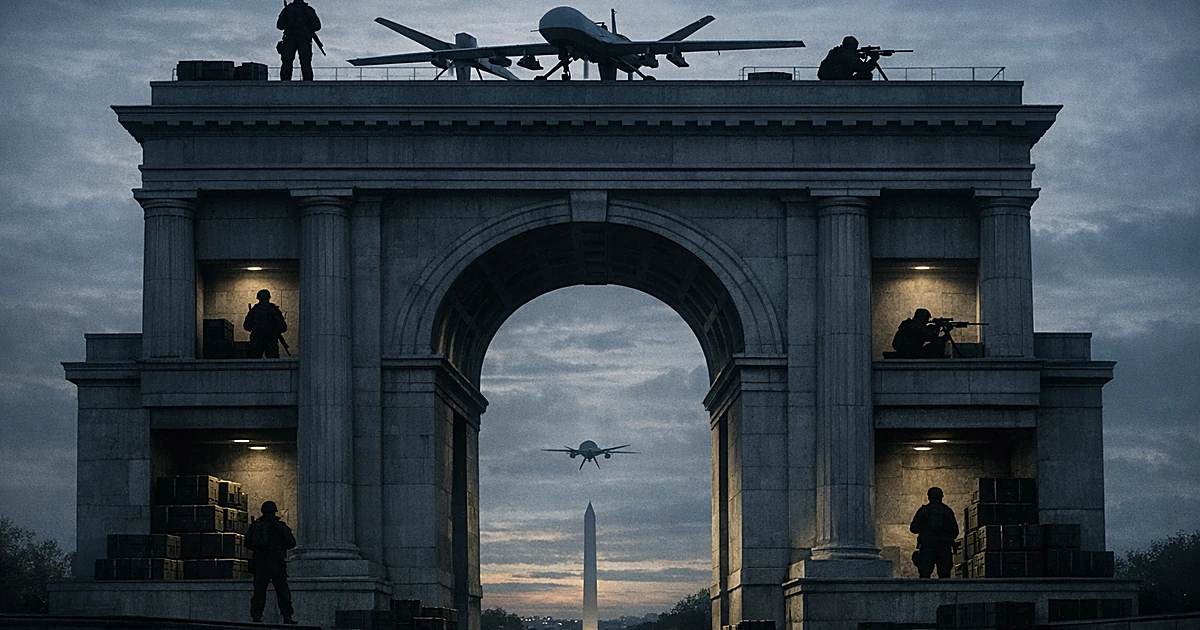
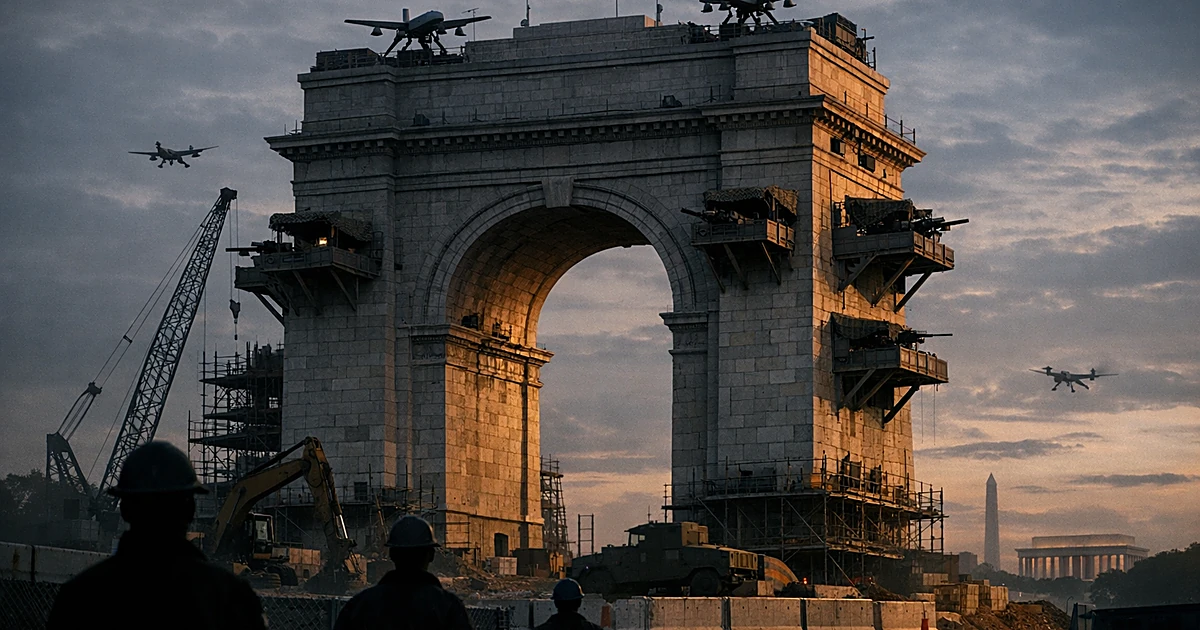
President Trump says his planned 250-foot triumphal arch near the Lincoln Memorial will be converted into a "top grade Military Complex" housing drones, sniper teams, and ammunition storage, a move he attributes to a "strong request" from the U.S. military.
Trump posted the announcement on Truth Social on Sunday, reframing what began as a ceremonial monument and Washington beautification project into a dual-purpose national security installation. The arch, slated for a site between the Lincoln Memorial and Arlington National Cemetery known as the Receptive Circle adjoining the Arlington Memorial Bridge, would store large numbers of drones, position snipers on both the roof and plaza areas, and hold quantities of sniper ammunition, all inside what the president still calls "the greatest" triumphal arch in the world.
The announcement marks a sharp turn for a project that Interior Secretary Doug Burgum promoted earlier in September as one of the "Great Pieces of American Architecture." Renderings showed a gilded arch roughly 250 feet tall, a monument, not an armory. Now the president says the military wants it loaded with ordnance and surveillance hardware.
Trump frames the conversion as a military necessity
In his Truth Social post, Trump cast the decision as a response to the armed forces, not his own initiative. Just The News reported the full scope of Trump's language:
"For National Security purposes, I have agreed to convert the magnificent Triumphal Arch, planned since the Civil War Era many years ago, at the Receptive Circle adjoining the Arlington Memorial Bridge, into a top grade Military Complex/Triumphal Arch."
Trump added that the facility would be unlike anything else on earth. He also claimed Washington, D.C., stands alone among "59 top cities and Capitals" worldwide in lacking a triumphal arch, a gap he pledged to close with what he called "by far, the greatest of them all."
No specific military branch or official has been identified as making the "strong request" Trump referenced. Breitbart reported that the Pentagon stated it had no information beyond the president's social media announcement, a notable gap between Trump's framing and the Defense Department's public posture.
That disconnect matters. If the military genuinely requested the conversion, the public deserves to know which commanders, which threat assessment, and which operational plan justified turning a memorial arch into an armed facility overlooking Arlington National Cemetery. If the request was informal or aspirational, the president's language overstates the case. Either way, the Pentagon's silence leaves the claim unverified.
FAA flags flight safety concerns a day before Trump's post
Just one day before Trump's Sunday announcement, the Federal Aviation Administration weighed in on the arch's physical dimensions. The FAA noted that the proposed structure would need an "eternal flame" to prevent it from becoming a flight safety hazard, given its proximity to Ronald Reagan Washington National Airport.
An FAA spokesperson told The Hill on Saturday that "floodlight projectors pointed towards the Arch to make it noticeable for pilots" would also be required. The agency's requirements add engineering and regulatory layers to a project that has yet to receive formal approval from the local planning commission.
Democratic lawmakers have raised airspace concerns even after the FAA cleared the structure of posing a direct hazard to flights at Reagan National. The New York Post reported that the FAA's clearance did not quiet critics who see a 250-foot armed structure near a major airport as an invitation for complications, particularly one that would now house drones capable of rapid deployment.
The drone storage component raises its own questions. Operating drones near restricted airspace around the National Mall and Reagan National Airport involves layers of federal regulation. Trump's post did not address how drone launches from the arch would interact with existing no-fly zones or FAA protocols.
Lawsuits and planning hurdles already dog the project
The military-complex conversion lands on top of an already contested project. Earlier this year, a group of veterans and an architectural historian filed a lawsuit seeking to block the arch entirely. Their complaint cited two core objections: the administration's failure to secure congressional approval before building on federal land, and the arch's proximity to Arlington National Cemetery, ground that carries deep meaning for military families and Gold Star survivors.
The lawsuit's current status is unclear from available reporting. But the plaintiffs' congressional-approval argument carries weight regardless of the outcome. Federal land use in the capital has historically required legislative authorization, and recent clashes between GOP senators and the White House over spending priorities suggest that even a Republican Congress may not rubber-stamp every presidential initiative.
A D.C. planning commission has not formally approved the arch plans. The commission has expressed concern about the project, though the specific nature of those concerns is not detailed in available reporting. Adding a military function, drones, ammunition storage, rooftop sniper positions, to a structure that a planning body has not yet approved for its original ceremonial purpose raises the stakes considerably.
$1 billion in reconciliation funds already earmarked for White House security
The arch announcement arrives against the backdrop of significant federal spending on Trump's other Washington construction priorities. Over the summer, GOP lawmakers passed a reconciliation package that included $1 billion for "the purposes of security adjustments and upgrades... relating to the East Wing Modernization Project, including above-ground and below-ground security features."
That billion-dollar line item covers the White House East Wing project, not the arch specifically. But the two efforts share a pattern: Trump has consistently framed his Washington building projects in security terms, layering national defense justifications onto what began as aesthetic or legacy undertakings. Elements of the White House Ballroom project have already drawn on Secret Service budget allocations, and some parts of that effort are caught up in their own legal challenges.
The question of who pays for the arch's military conversion remains unanswered. No cost estimate for the expanded project has been made public. A 250-foot structure capable of storing drones and ammunition, housing sniper teams, and meeting FAA lighting requirements would carry a price tag far beyond a conventional memorial, and the funding source matters to every taxpayer footing the bill.
This is not the first time the administration's ambitious plans have drawn resistance from within its own coalition. Congressional action on major legislation has moved at its own pace this term, and lawmakers have shown a willingness to assert their own priorities even when the White House pushes hard.
From "Great Piece of Architecture" to armed installation in weeks
The timeline tells its own story. In October 2025, Trump held models of the arch during a ballroom dinner in the White House East Room. Earlier this September, Burgum promoted the project as an architectural achievement, sharing gilded renderings on social media. By Sunday, the arch had become a military complex.
That rapid evolution, from monument to armory in a matter of months, has drawn no public objection from Burgum or other administration officials. The project that was sold to the public as a tribute to American greatness and a remedy for Washington's supposed lack of a triumphal arch now carries a fundamentally different character. Storing ammunition and positioning snipers on a rooftop overlooking Arlington National Cemetery is not beautification. It is a military posture.
Trump's claim that the arch was "planned since the Civil War Era" adds historical weight to the project, though the source of that claim is not specified. Washington has debated memorial arches at various points in its history, but the current design and its military conversion are entirely products of this administration.
Legal and political resistance to the administration's broader agenda continues on multiple fronts. Lawsuits challenging administration policies have become a regular feature of the political landscape, and the arch project now joins that list.
The open questions are substantial. Which military leaders requested the conversion, and what threat justified it? How will drone operations interact with restricted airspace? What is the projected cost, and where will the money come from? Will Congress weigh in, or will the administration proceed without legislative approval? And how do the veterans who filed suit, people who served the country the arch ostensibly honors, feel about sniper teams stationed above the graves of their fellow service members?
None of those questions have public answers yet. The Pentagon offered nothing beyond Trump's post. The planning commission has not approved the original design, let alone the armed version. The lawsuit remains unresolved.
Meanwhile, fractures within the president's own party on other policy fronts suggest that even allies may not follow every presidential initiative without scrutiny. A monument is one thing. An armed compound between the Lincoln Memorial and Arlington National Cemetery is something else entirely, and it deserves the kind of rigorous public debate that a Truth Social post cannot provide.
When the government wants to build an armory on sacred ground, the least it owes the public is a straight answer about why, and who asked.