Courts stretch Second Amendment past firearms as AR-15 showdown nears
Federal courts just extended Second Amendment protection to switchblades and body armor, twin rulings gun-rights advocates say preview a looming Supreme Court fight over AR-15 rifles.
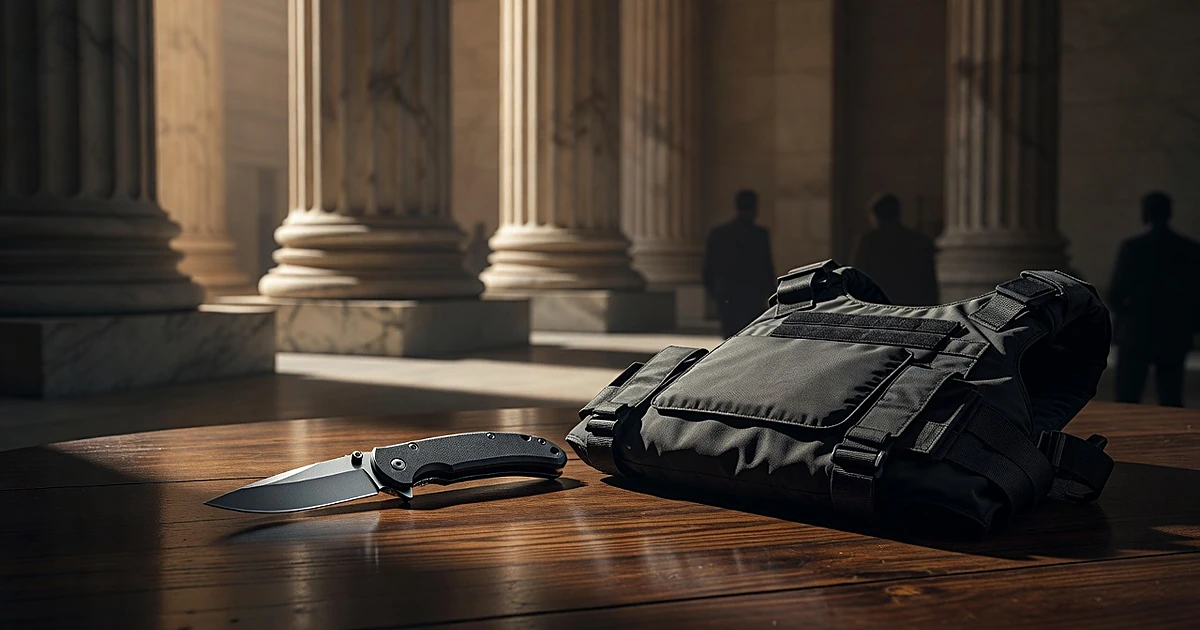
Two federal decisions landed on the same Wednesday and pushed the right to keep and bear arms well past conventional guns. The Fifth Circuit Court of Appeals held that a federal law restricting interstate commerce in switchblade knives violates the Second Amendment. A federal judge in the Western District of New York struck down New York’s limits on personal body armor for civilians.
Both courts treated the items as constitutionally protected “arms.” That framing now sits next to a much larger fight. The Supreme Court is preparing to hear oral arguments in Viramontes v. Cook County, a challenge that could decide whether AR-15-style rifles count as protected arms under the same constitutional test.
Fox News reported that the twin rulings fueled optimism among gun-rights advocates who see the coming AR-15 case as the real hinge for how far lower courts will go.
Knives and armor cleared the text-and-history test
The Fifth Circuit applied the framework from the Supreme Court’s Heller and Bruen decisions. First, does the Second Amendment’s text cover the weapon or conduct? If yes, the government must show a historical tradition of similar regulation.
The appeals court found switchblades are commonly used arms protected by the Second Amendment, pointing to historical use for defense and everyday purposes. It concluded the government failed to identify a sufficient historical tradition for the Federal Switchblade Act’s specific interstate commerce restrictions, which regulated those knives in a way that differed from historical laws.
In New York, the federal judge rejected the state’s claim that body armor is merely a tactical accessory to a firearm rather than an “arm.” The court held that body armor falls within the historical definition of arms recognized in Heller, a term that covers both offensive weapons and defensive armor, and that New York had not shown a historical tradition supporting its civilian purchase ban.
Second Amendment attorney George Lyon said the burden shift is the whole ballgame once the text is satisfied.
"Once what you want to do is shown to come within the text of the Second Amendment, the presumption is that the regulation is unconstitutional,"
Lyon argued the governments in both cases failed to identify sufficiently similar historical laws. That is the Bruen test in plain English: history first, modern policy preferences second.
Viramontes could settle what counts as an “arm”
Dudley Brown, president of the National Association for Gun Rights, tied the knife and armor wins directly to the Supreme Court’s next move. His group filed an amicus brief in Viramontes.
"The interesting thing about both of these cases is that they’re both going to be really decided by the U.S. Supreme Court in the Viramontes decision,"
Cook County’s assault-weapons ban is at the center of that case. The Seventh Circuit had concluded AR-15-style rifles were comparable to machine guns and therefore fell outside the category of arms protected by the Second Amendment. Lyon called that comparison a fundamental error under Heller.
"The current case at the Supreme Court, Viramontes, will address that because the Seventh Circuit had taken the position that because AR-15s are ‘like machine guns,’ they don’t constitute an arm as defined under Heller,"
He added, "That was just totally wrong in my view."
Readers tracking a landmark High Court Second Amendment fight already saw the Court accept two assault weapons ban cases that set the stage for a major ruling on the scope of protected arms.
Heller, decided in 2008, recognized an individual right to possess firearms for lawful purposes including self-defense. It protects weapons in lawful common use and acknowledges a tradition of restricting “dangerous and unusual” weapons. Bruen later locked in the text-and-history method that lower courts used this week on knives and armor.
Lower courts keep testing bans after Bruen
Justin Davis, director of public affairs for the National Rifle Association, framed the moment as a wider fight over the definition of arms itself, not only rifles, but gear people use to defend themselves.
"There’s a major discussion going on in the courts about what is and what aren’t arms,"
Davis pointed to litigation over suppressors, ammunition magazines, stun guns, pepper spray, and other self-defense equipment. He rejected the claim that the Second Amendment froze technology in the 18th century.
"They talk about how the Second Amendment only applied to muskets because that’s what existed at the time of the Founders, but we don’t apply the First Amendment only to newspapers, books or speech in public forums,"
"Social media, texting and phones didn’t exist at that time, either," he said. "The world evolves, but the core fundamental rights never change."
That same post-Bruen pressure is showing up in other circuits. Breitbart reported that the Third Circuit on Friday struck down New Jersey’s ban on assault weapons and high-capacity magazines as unconstitutional, another lower-court rejection of broad state gun restrictions after the Supreme Court’s history test.
The pattern is not limited to one type of firearm statute. The Supreme Court also left intact a Fifth Circuit ruling that simple drug possession cannot erase gun rights, another signal that circuit courts are policing how far the government may go when it burdens lawful arms.
Policy fights keep landing at the same constitutional line
New York argued body armor was an accessory, not an arm. Cook County’s ban regime treated common semi-automatic rifles as if they were machine guns. The Federal Switchblade Act’s interstate limits failed the historical-tradition showing the Fifth Circuit demanded.
In each dispute, officials reached for modern safety rationales. Courts answered with the same two-step method: text first, then history. When the government cannot find a close historical match, the regulation falls.
That is why gun-rights groups read Wednesday’s knife and armor decisions as more than one-off wins. They see a consistent rule that will matter when the justices take up AR-15-style rifles in Viramontes. If those rifles are “arms” in common lawful use, the burden shifts hard against categorical bans.
The Court has moved on other high-stakes questions in the same term, including when it cleared the way for third-country deportations of illegal immigrants, proof that major constitutional and enforcement fights keep returning to the same nine justices.
Absolute calendar dates for the Wednesday rulings and the Viramontes argument slot were not laid out in the initial reporting. Case captions and full opinion excerpts were also thin in the public write-ups. The operative holdings were not. Switchblades and body armor cleared the arms threshold. The historical-tradition defense failed. AR-15s are next in line for the same analysis.
Lawful residents who buy common defensive tools should not need a permission slip from a county board that rewrites “arms” to mean “whatever we still allow.” Courts that enforce the text and the history are doing the job the Constitution assigned them, and the Supreme Court’s AR-15 case will show whether that standard holds when the political pressure is highest.