NYPD body camera footage shows officer fatally shooting machete-wielding man who slashed three elderly victims at Grand Central
Authorities have released body camera video showing the moment an NYPD detective shot and killed a man who had just slashed three elderly people with a machete inside one of the busiest transit hubs in America. The footage captures the final seconds of a rampage that left a 65-year-old with an open skull fracture and two other senior citizens hospitalized, and it shows exactly why the officer pulled the trigger.
The attack unfolded on April 11 at the Grand Central Terminal subway station in New York City. Anthony Griffin, 44, allegedly went up the stairs from the fourth, fifth, and sixth subway platform carrying a machete and began attacking strangers. His victims, ages 65, 70, and 84, did not know each other. They were simply riding the train.
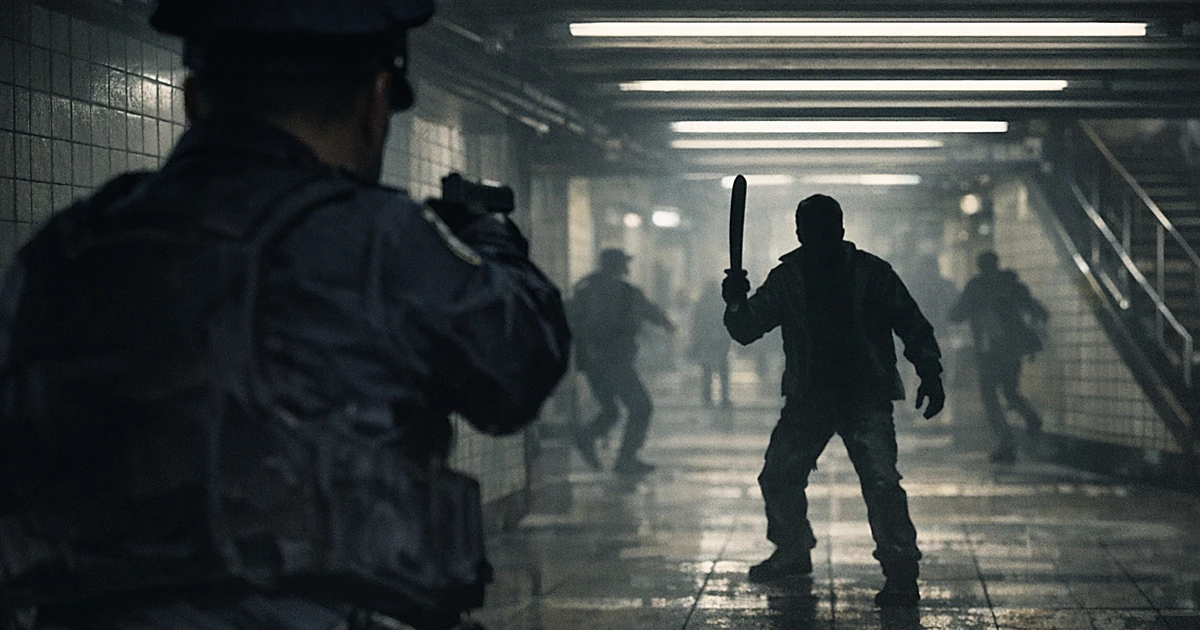
Police said Griffin ignored more than 20 commands to drop the weapon. He yelled, "I am Lucifer." He told officers, "I don't want to be here. Shoot me." Then he advanced toward Detective Ryan Giuffre with the blade extended. Giuffre fired two shots. Griffin fell and was later pronounced dead at a hospital.
What the body camera captured
The newly released footage, first reported by Breitbart, shows NYPD officers confronting Griffin as he held the machete and refused to comply. Additional video posted to social media showed police at the scene and what appeared to be bloody cloths on the floor. A separate image circulated online showed the machete Griffin was carrying.
The detectives involved had been working overtime providing transit security when they encountered Griffin. Two of those detectives were later treated at a hospital for tinnitus caused by the gunfire in the enclosed station.
NYPD Commissioner Jessica Tisch described the confrontation in stark terms. The New York Post reported her statement:
"The individual was armed with a large knife described as a machete and was behaving erratically, repeatedly stating that he was Lucifer."
Tisch added: "One officer discharged his firearm striking the perpetrator twice."
Three elderly victims, three random encounters
The victims had no connection to each other or to Griffin. They were strangers on a subway platform who crossed paths with a man carrying a machete. The 65-year-old suffered the worst: an open skull fracture, which police described as a severe head injury putting the brain at high risk of injury or infection. All three were transported to area hospitals and reported in stable condition.
ABC 7 reported on April 12 that the victims appeared to have had "chance encounters" with Griffin. The station's reporting characterized Griffin as someone "who was set on causing severe harm to people who were simply taking the train." That framing, from a local news outlet, not from police, underscores the randomness of the violence. There was no dispute, no provocation. Just a man with a machete and elderly people waiting for a train.
This is the kind of subway violence that has driven growing public concern about safety in New York's transit system, even as city officials point to broader crime statistics trending downward.
Griffin's prior record
Griffin was not unknown to law enforcement. He had a previous run-in with police for menacing with a sharp object. The details of that prior encounter, when it happened, what jurisdiction handled it, and what consequences followed, remain unclear from available reporting. But the pattern is hard to ignore: a man previously flagged for threatening people with a blade allegedly returned to do far worse.
That question, what happened between Griffin's earlier encounter with the law and his rampage at Grand Central, is one investigators should answer. The NYPD said its Force Investigation Division, along with the prosecutor with jurisdiction, are still investigating and analyzing the incident.
Across the country, communities have grappled with similar failures to intervene before repeat offenders escalate. In Cincinnati, a police chief was recently fired for refusing to put more officers on the street as violent crime surged, a reminder that leadership decisions have consequences measured in blood.
Officers acted to stop the threat
Fox News reported that officers attempted to de-escalate the situation before resorting to lethal force. They gave Griffin more than 20 verbal commands to drop the machete. He refused every one. He declared himself "Lucifer." He asked to be shot. And then he moved toward a detective with the blade.
Governor Kathy Hochul acknowledged the officers' actions. "I'm grateful to our brave officers who acted quickly to stop the suspect," she wrote.
The body camera footage, now public, tells a straightforward story. Officers gave Griffin every chance to put down the weapon. He chose not to. When he advanced, a detective did what he was trained to do.
The Associated Press confirmed that Griffin said both "I am Lucifer" and "I don't want to be here. Shoot me" in the body camera video. Whatever was driving Griffin that day, mental illness, malice, or something else, the result was three elderly people carved up in a subway station and a man who refused to stop until he was stopped.
Open questions remain
Several facts remain unresolved. No charges were publicly filed against Griffin before his death, and it is unclear whether any would have been pursued posthumously for investigative purposes. The specific prosecutor handling the case has not been named. The names of the three victims have not been released.
Griffin's prior arrest for menacing with a sharp object raises the most pressing question: Was he released without meaningful consequences? Was he offered treatment? Did anyone flag him as a potential danger? Those answers matter, not just for this case, but for the next one.
New York City's transit system has become a recurring stage for violent attacks against vulnerable people. From abandoned children in Times Square to machete attacks at Grand Central, the pattern is the same: ordinary people going about their lives, exposed to danger in spaces the city is supposed to keep safe.
The detectives who confronted Griffin were working overtime to provide transit security. That detail deserves attention. If the city needs overtime patrols to keep Grand Central Station safe from machete attacks, the baseline staffing and intervention systems are not working.
Meanwhile, other high-profile cases continue to raise questions about whether law enforcement agencies are deploying resources effectively before threats materialize, not just after.
The footage speaks for itself
In an era when police use of force is scrutinized frame by frame, the release of this body camera video serves a purpose. It shows officers who tried to talk a man down. It shows a suspect who refused. It shows the moment a detective had no choice left.
Three elderly New Yorkers, a 65-year-old with a fractured skull, a 70-year-old, and an 84-year-old, paid the price for whatever failures allowed Anthony Griffin to walk into Grand Central Terminal with a machete. The officer who stopped him should not have to apologize for it.
When the system fails to keep dangerous people off the streets, someone else has to clean up the mess. On April 11, that someone was Detective Ryan Giuffre. He did his job. The question is why the system didn't do its job first.