F-16s intercept plane over Cincinnati while Trump holds nearby rally
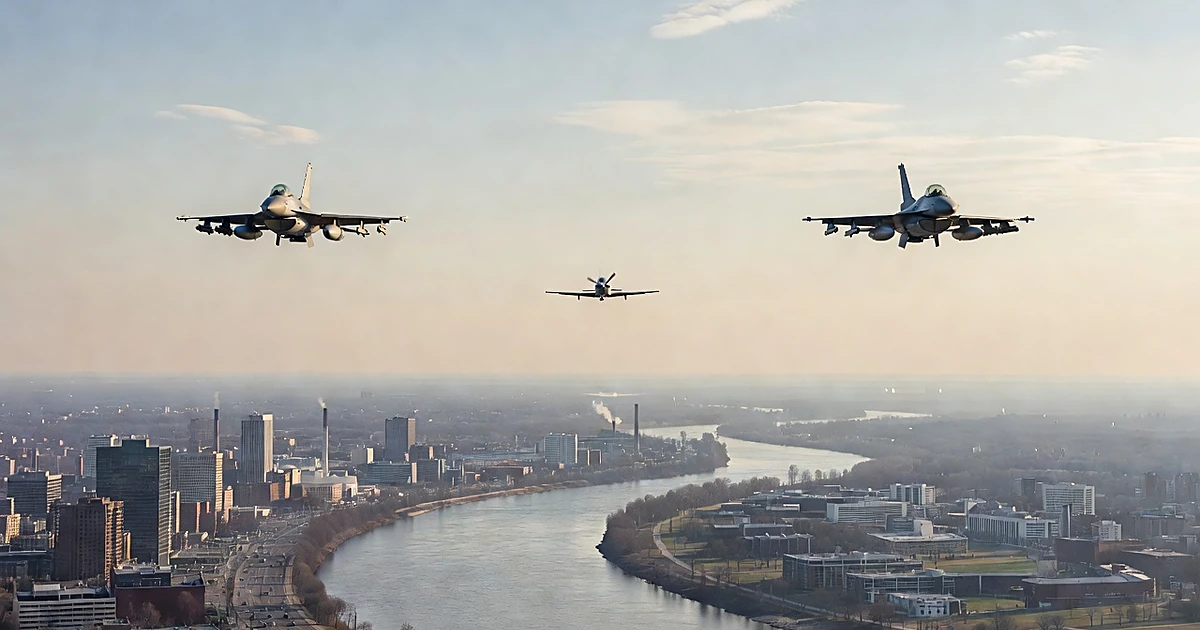
F-16 fighter jets intercepted and escorted a general aviation plane out of restricted airspace over Cincinnati on Saturday while President Trump spoke at a rally just south of the city.
Around 3 p.m. CT, U.S. military aircraft moved in after the plane entered temporary flight restrictions tied to the president’s appearance at the Northern Kentucky University campus, just across the river from Cincinnati. CBS News reported that the jets safely guided the aircraft out of the area with no injuries or damage described.
The North American Aerospace Defense Command confirmed the intercept. Temporary flight restrictions are routine around high-profile political events, and the Federal Aviation Administration issues them so pilots know the limits through Notices to Airmen, or NOTAMs, that update regularly.
President Trump’s schedule has drawn repeated airspace protections this year. Lawful residents and taxpayers expect the same serious posture that has long guarded national leaders from both careless mistakes and deliberate threats.
NORAD warns pilots face real consequences
NORAD made the stakes plain for anyone who ignores the rules. Pilots who violate temporary flight restrictions may face follow-up on the ground.
The command stated that violators may “be met by federal authorities upon landing and subject to interview or further enforcement action.”
"be met by federal authorities upon landing and subject to interview or further enforcement action."
That language leaves little room for casual excuses. The next day, Air Force officials reminded pilots to check airspace limits while planning flights and before takeoff. The message was simple: read the notices or risk a military escort and a federal interview.
Presidential movements require layers of protection that ordinary travelers never see. Recent coverage of Barron Trump’s guarded life has underscored how constant those security demands remain for the entire family.
Earlier intercepts tracked Trump’s travel
Saturday’s scramble was not an isolated episode. At the end of September, F-16s intercepted a group of 15 planes that violated restrictions over the Chicago area while Trump was visiting.
In August, fighter jets stopped a civilian plane that entered restricted air over Geneva, Ohio, where Trump attended the 2026 Patriot Games. Jets also scrambled around the same time over Bedminster, New Jersey, home to one of his golf courses. Those planes were safely escorted as well.
In July, NORAD reported planes violated flight restrictions set for the World Cup final over East Rutherford, New Jersey. Again, the aircraft left the area under military escort. The pattern is consistent: when the president is on the ground, the airspace above him is closed for a reason.
Federal agencies treat those zones as non-negotiable. The same mindset shows up in cases where authorities move fast against explicit danger, including the FBI arrest of an Ohio man over graphic threats aimed at President Trump.
FAA rules leave little ambiguity
The FAA creates temporary flight restrictions around high-profile events, especially those attended by politicians. Information reaches pilots through NOTAMs that are released and updated on a regular schedule. Military officials did not spell out a unique motive for the Cincinnati restriction beyond that standard practice.
General aviation pilots still carry the duty to know where they can and cannot fly. When they miss the notice, F-16s become the last line that keeps the zone clear. No tail number, pilot name, origin, or destination for the Cincinnati plane has been released. No arrest or charge has been publicly detailed either.
What is public is the response itself: jets up, plane escorted out, reminder issued the next day. That sequence matches the earlier stops in Chicago, Geneva, Bedminster, and East Rutherford. Each time the aircraft left safely. Each time the restriction held.
Protecting a sitting president has always required more than ground perimeters. Decoy flights and other tactics have long been part of the toolkit, a point reinforced when the Secret Service director confirmed decoy Air Force One measures used for Trump before.
Open questions remain after the escort
Key details stay unanswered. The exact calendar date beyond “Saturday” is not listed in the available accounts. Whether federal authorities met the pilot after landing is not stated. The precise text of the full NORAD release and the Air Force social post is not reproduced beyond the enforcement warning and the Sunday reminder.
Those gaps do not change the verified core. A general aviation plane entered restricted air over Cincinnati while Trump spoke nearby. F-16s intercepted it. The plane left under escort. Officials then told other pilots to pay attention before they take off.
Readers who follow Trump family developments have also tracked health updates such as Kai Trump’s recent wrist surgery, another reminder that public attention stays fixed on the people closest to the president even when the day’s news centers on security hardware in the sky.
Common-sense rules still apply in the air. Temporary flight restrictions exist so one careless flight does not become a larger crisis. When pilots ignore them, the military answer has been swift and controlled.
A free country can keep its leaders safe without apology. Clear airspace rules, ready jets, and real consequences for violations are how that gets done.